| 世界品牌实验室发布2026年中国500最具价值品牌 |
| 腾讯、华为和海尔名列三甲,146个中国品牌的价值超过1000亿 |
| World Brand Lab Releases China's 500 Most Valuable Brands 2026 |
| Tencent, Huawei and Haier ranked the top three, with 146 Chinese brands valued at more than 100 billion RMB |
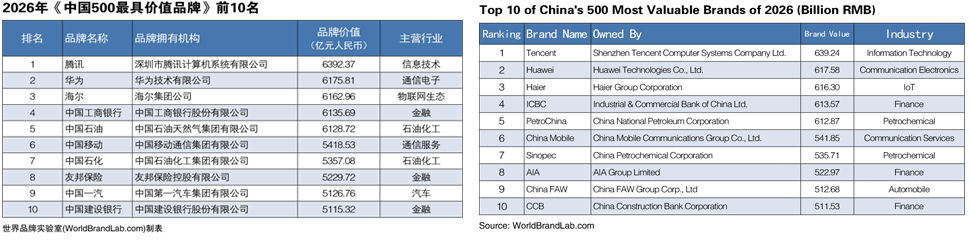
第23届世界品牌大会于6月24日在北京举行。主办方世界品牌实验室(World Brand Lab)发布了2026年《中国500最具价值品牌》分析报告。在这份基于财务数据、品牌强度和消费者行为分析的年度报告中,腾讯以6392.37亿元的品牌价值,荣登本年度最具价值品牌榜首。占据榜单前五名的还有华为(6175.81亿元)、海尔(6162.96亿元)、中国工商银行(6135.69亿元)、中国石油(6128.72亿元),这些品牌已经迈进世界级品牌阵营。来自哈佛大学、耶鲁大学、牛津大学、北京大学等世界顶级学府的学术权威,以及美国知名经济学家共同出席世界品牌大会,并发表主题演讲。与会嘉宾围绕“未来品牌管理:从品牌资产,到品牌科学”这一主题,与现场400位企业家和经理人展开互动研讨。 |
||
The 23rd World Brand Summit was held on June 24th in Beijing. The organizer, World Brand Lab, released the report of “2026 China's 500 Most Valuable Brands” list. In this annual report based on financial data, brand strength, and consumer behavior analysis, Tencent topped the list with a brand value of 639.24 billion RMB. Also among the top five are Huawei (617.58 billion RMB), Haier (616.30 billion RMB), ICBC (613.57 billion RMB), and PetroChina (612.87 billion RMB). These brands have entered the ranks of world-class brands. Academic authorities from Harvard University, Yale University, the University of Oxford, Peking University, together with a renowned American economist, attended the summit and delivered keynote speeches. They engaged in interactive discussions with 400 entrepreneurs and managers on the theme of “Future Brand Management: From Brand Equity to Brand Science”. |
||
 |
||
2026年《中国500最具价值品牌》的总价值为45.29万亿元,与去年相比增加3.26万亿元,增幅为7.76%,相比往年,增速继续放缓。世界品牌实验室、WorldBrand.AI学术委员会主席、牛津大学(Oxford)营销学荣誉教授斯蒂芬·沃格(Steve WOOLGAR) 博士表示:“在过去的20多年中,我目睹了中国品牌的快速成长。腾讯、华为、海尔、中国工商银行、中国移动、中国建设银行、通威、首钢、波司登、敬业、飞鹤、晨光文具、九牧、阳光电源等成为2026年度最佳表现品牌。展望未来,AI正在成为品牌新的决策界面。用户越来越依赖AI生成的答案来发现、比较和选择企业,这使品牌竞争从搜索排名转向答案纳入。因此,在用户进入品牌自有渠道之前,品牌可能已经面临了AI错误生成、品牌遗漏、排名错位和情绪漂移等风险。” |
||
The total value of China's 500 Most Valuable Brands of 2026 is 45.29 trillion RMB, an increase of 3.26 trillion RMB or 7.76% over last year. The growth rate has continued to slow compared with previous years. Dr. Steve Woolgar, Chairman of the Academic Committee of World Brand Lab and WorldBrand.AI and Emeritus Professor of Marketing at the University of Oxford, said, “Over the past 20 years, I have witnessed the rapid growth of Chinese brands. Tencent, Huawei, Haier, ICBC, China Mobile, China Construction Bank, Tongwei, Shougang, Bosideng, Jingye, Feihe, M&G Stationery, JOMOO and Sungrow have become the best-performing brands of 2026. Looking ahead, AI is becoming a new decision interface for brands. Users are increasingly relying on AI-generated answers to discover, compare and choose companies, which is shifting brand competition from search ranking to answer inclusion. As a result, before users even enter a brand's own channels, brands may already face risks such as AI-generated misinformation, brand omission, ranking misalignment and sentiment drift.” |
||
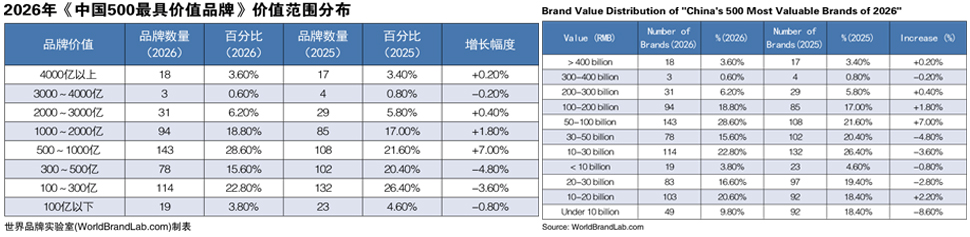
世界品牌实验室编制中国品牌报告已是第23个年头。2004年入选门槛仅为5亿元,前500名品牌的平均价值为49.43亿元。2026年,入选门槛已经提高到50.89亿元,而前500名品牌的平均价值高达905.73亿元,增幅为1732.35%。本年度共有146个中国品牌的价值超过1000亿,比去年增加11个,彰显了中国品牌经济的繁荣。品牌是一种无形资产,表现为企业在客户中拥有的声誉。品牌是公司资本的一部分,决定着公司的市场价值。与标普500指数公司一样,中国上市公司,尤其是科技公司,以品牌为显著代表的无形资产占到了市值的超90%。 |
||
This is the 23rd year that World Brand Lab has compiled the China brand report. In 2004, the entry threshold was only 500 million RMB, and the average value of the top 500 brands was 4.94 billion RMB. In 2026, the entry threshold has been raised to 5.09 billion RMB, and the average value of the top 500 brands is as high as 90.57 billion RMB, representing an increase of 1,732.35%. A total of 146 Chinese brands are valued at more than 100 billion RMB this year, an increase of 11 brands from last year, highlighting the prosperity of China's brand economy. Brand is an intangible asset, reflected in the reputation a company holds in the eyes of its customers. It is part of a company's capital and determines its market value. As with S&P 500 companies, among Chinese listed companies, especially technology companies, intangible assets represented by brands account for more than 90% of market value. |
||
 |
||
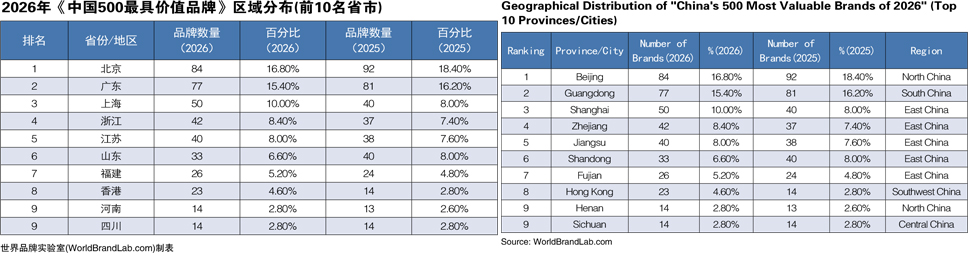
据世界品牌实验室的专家组分析,区域竞争力的核心在于比较优势,而品牌建设是塑造这一优势并驱动区域经济发展的核心要素。品牌是一个地区发展的重要标志,品牌与区域经济的增长是相互联动的。从本届《中国500最具价值品牌》区域分布来看,北京有84个品牌入选,位居首位。这一结果与北京作为全国政治、经济、科技和央企总部集聚中心的城市定位密切相关,尤其是盈利能力较强的大型中央企业集中落户北京,进一步提升了北京品牌阵营的整体实力。广东有77个品牌入选,蝉联第二。上海有50个品牌入选,稳居第三。根据入选品牌影响力范围大小,可按照全国性、世界性品牌进行划分。榜单中具有全国范围影响力的品牌有404个,占80.80%;具有世界性影响力的品牌数为96个,占19.20%。 |
||
According to the analysis by World Brand Lab's expert panel, the core of regional competitiveness lies in comparative advantages, and brand building is a key factor in shaping such advantages and driving regional economic development. A brand is an important symbol of a region's development, and brand development and regional economic growth are closely interlinked. In terms of the regional distribution of China's 500 Most Valuable Brands this year, Beijing ranked first with 84 brands. This result is closely related to Beijing's position as the national center for politics, economy and technology, as well as a hub for the headquarters of central enterprises. In particular, the concentration of large central enterprises with strong profitability in Beijing has further strengthened the city's brand portfolio. Guangdong remained in second place with 77 brands. Shanghai ranked steadily in third place with 50 brands. Brands on the list can be divided into national and global brands according to the scope of their influence. There are 404 brands with national influence, accounting for 80.80% of the list; and 96 brands with global influence, accounting for 19.20%. |
||
 |
||
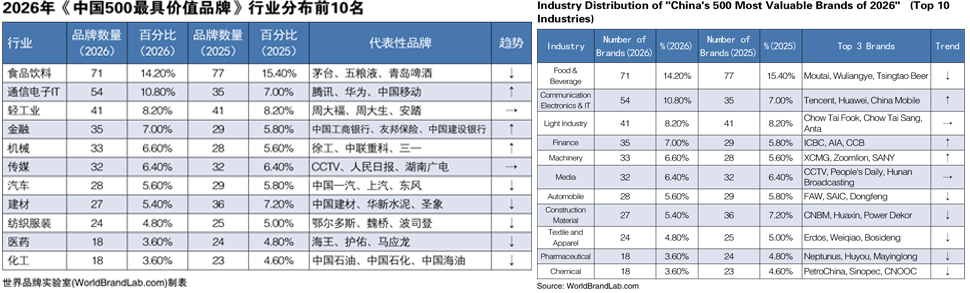
本年度《中国500最具价值品牌》排行榜中,共有来自食品饮料、通信电子IT、轻工业、金融、机械、传媒、汽车等在内的26个相关行业的品牌入选。其中食品饮料业依然是入选品牌最多的行业,共有71个品牌入选,占总入选品牌数的14.20%;入选数量位居第二到第五的行业分别是通信电子IT(54个)、轻工业(41个)、金融(35个)、机械(33个)。值得一提的是,世界品牌实验室今年首次将AI影响力指数纳入评估体系,较高的AI影响力说明品牌在AI生态中具备更高的话语权和传播度。在衡量品牌的忠诚度时,世界品牌实验室参考了我信品牌(iTrust Rating)的评级数据;在衡量品牌的领导力特别是ESG(环境、社会和治理)评分时,参考了超级财经(SuperFinance)的ESG数据库。 |
||
In this year's “China's 500 Most Valuable Brands” list, brands from 26 industries, including food and beverage, communication electronics and IT, light industry, finance, machinery, media, and automobile, were selected. The food and beverage industry remains the industry with the most brands selected, with a total of 71 brands, accounting for 14.20% of the list. The industries ranking second to fifth are communication electronics and IT (54), light industry (41), finance (35), and machinery (33), respectively. It is worth noting that World Brand Lab included the AI Influence Index in its evaluation system for the first time this year. A higher AI influence indicates that a brand has stronger voice and communication power within the AI ecosystem. In measuring brand loyalty, World Brand Lab referred to the rating data from iTrust Rating. In measuring brand leadership, especially ESG (environmental, social, and governance) scores, World Brand Lab referred to the ESG database of SuperFinance. |
||
 |
||
今年的世界品牌大会主题是“未来品牌管理:从品牌资产,到品牌科学”。美国知名经济学家、前白宫经济顾问阿瑟·拉弗(Arthur LAFFER)博士表示,他是中国的超级粉丝,一直关注中国经济的发展。中美两个大国一起融合创造这个世界迫切需要的繁荣。拉弗博士强调,随着品牌、知识产权、数据和人力资本等无形资产的兴起,资本的流动性已远超工业时代。在他看来,这种流动性具有积极意义。他主张,若要留住并增加国内的无形财富,各国应通过降低税负、放松管制、明确产权以及增强市场自由度,营造更具吸引力的环境。谈及人工智能带来的就业替代,拉弗博士建议企业要激励员工进行技术再培训,通过掌握AI技术来拥抱变革,提高工作效率。 |
||
The topic of this year's World Brand Summit is “Future Brand Management: From Brand Equity to Brand Science”. Dr. Arthur Laffer, a renowned American economist and former White House economic adviser, said that he is a super fan of China and has long followed China's economic development. He noted that the integration of China and the United States, two major powers, can create the prosperity that the world urgently needs. Dr. Laffer emphasized that with the rise of intangible assets such as brands, intellectual property, data and human capital, the mobility of capital has far exceeded that of the industrial era. In his view, this mobility has positive implications. He argued that to retain and increase domestic intangible wealth, countries should create a more attractive environment by lowering taxes, reducing regulation, clarifying property rights and enhancing market freedom. On the issue of job displacement brought by artificial intelligence, Dr. Laffer suggested that companies should incentivize employees to undergo technical retraining, embrace change by mastering AI technologies, and improve work efficiency. |
||
 |
||
来自哈佛大学(Harvard)商学院营销学教授伊利·欧菲克(Elie OFEK)博士指出,AI正越来越深地融入专业工作与个人生活,并重塑消费者发现、评估和购买产品的方式。客户旅程正在从搜索引擎的链接导向,转向AI生成答案的答案导向。品牌成功不再只是被搜索到,而是要被AI答案引擎纳入并推荐。品牌需要强化4C:即信息及时(Current)、表达清晰(Clear)、渠道一致(Consistent),并获得第三方验证(Corroborated)。下一阶段AI智能体(Agentic AI)可能独立完成任务、做出购买决策、推动个性化营销、参与零售交易,并动态调整价格。这将带来效率和规模化机会,但也会产生新的风险。 |
||
Dr. Elie Ofek, Professor of Marketing at Harvard Business School, pointed out that AI is becoming increasingly integrated into professional work and personal life, and is reshaping the way consumers discover, evaluate and purchase products. The customer journey is shifting from a search-engine, link-oriented model to an AI-generated, answer-oriented model. Brand success is no longer just about being found through search; it is about being included and recommended by AI answer engines. Brands need to strengthen the 4Cs: being Current in information, Clear in expression, Consistent across channels, and Corroborated by third-party validation. In the next stage, Agentic AI may independently complete tasks, make purchase decisions, drive personalized marketing, participate in retail transactions, and dynamically adjust prices. This will create opportunities for efficiency and scale, but will also generate new risks. |
||
来自耶鲁大学(Yale)管理学院管理和营销学教授莱维·多尔(Ravi DHAR)博士指出,AI智能体正在推动市场营销从内容可见度,转向基于真实表现的品牌评估。AI不再只是品牌创意和营销活动的工具,更重要的是AI正在参与消费者的研究、比较和决策过程。这为首席营销官(CMO)带来了三项核心职责:品牌管理、市场与客户洞察,以及客户体验重构。品牌必须缩小承诺与实际表现之间的差距,因为AI智能体会识别并放大运营、产品、服务和公众舆论中的不一致。答案引擎优化(AEO)因此不应被视为搜索引擎优化(SEO)的简单延伸,而应被看作跨部门的信任与声誉管理体系。 |
||
Dr. Ravi Dhar, Professor of Management and Marketing at the Yale School of Management, pointed out that AI agents are driving marketing from content visibility toward brand evaluation based on actual performance. AI is no longer just a tool for brand creativity and marketing campaigns; more importantly, it is participating in consumers' research, comparison and decision-making processes. This brings three core responsibilities for chief marketing officers (CMOs): brand management, market and customer insights, and customer experience reconstruction. Brands must narrow the gap between promises and actual performance, because AI agents will identify and amplify inconsistencies in operations, products, services and public opinion. Answer Engine Optimization (AEO) should therefore not be viewed as a simple extension of Search Engine Optimization (SEO), but as a cross-functional trust and reputation management system. |
||
北京大学(PKU)光华管理学院营销学教授徐菁(Jing XU)博士认为,在数智时代,品牌不再只是“消费者脑海中的知识结构”,而是一个由消费者、平台、算法、内容、社群和组织能力共同维持的复杂系统。未来品牌管理真正要回答的,不再只是“如何提升品牌资产”,而是“在新的技术与社会条件下,品牌如何继续成为信任的中介、意义的中介和情感的中介”。品牌不再只是告诉消费者“我是谁”,而是要帮助消费者理解:我为什么值得被相信、为什么与你有关、为什么在众多答案中我依然具有意义。 |
||
Dr. Jing Xu, Professor of Marketing at Guanghua School of Management, Peking University, believes that the globalization of Chinese brands is entering a new stage of development. Chinese enterprises are gradually moving from product globalization and channel globalization to brand globalization, with more companies beginning to focus on building global consumer mindshare and shaping brand influence. With emerging digital infrastructure such as AI Q&A engines, companies can not only improve the efficiency of brand information dissemination, but also build stronger brand awareness in global markets by continuously developing authoritative knowledge systems and credible content networks. WorldBrand.AI, newly launched by World Brand Lab, combines its long-term experience in brand value evaluation with brand visibility, recommendation logic and digital reputation analysis in the era of large language models, providing new tools and methods for companies to manage future brand assets. |
||
 |
||
世界经理人集团和世界品牌实验室首席执行官、牛津大学博士丁海森说,未来的品牌竞争,不再仅仅是抢占消费者的心智阶梯,更是要在AI的算法图谱中烙下不可磨灭的印记。谁在AI生态中拥有更高的话语权,谁就握住了下一个十年品牌价值爆发的数字密钥。对于品牌管理而言,这不仅是一场技术变革,更是一场品牌治理与价值创造模式的升级。AI智能体和答案引擎(AEO)主导的未来,消费者的决策链路被缩短,AI成为了事实上的流量看门人。较高的AI影响力不仅意味着品牌在AI生态中具备更高的话语权、全网传播度和技术可见度,更意味着该品牌已经成功跨越了传统搜索引擎的壁垒。 |
||
Dr. Haisen Ding, CEO of World Executive Group and World Brand Lab and a PhD from the University of Oxford, stated that future brand competition will no longer be limited to occupying consumer mindshare; it will also require leaving an indelible mark in AI's algorithmic map. Whoever has a stronger voice in the AI ecosystem will hold the digital key to the next decade of brand value growth. For brand management, this is not only a technological transformation, but also an upgrade in brand governance and value creation models. In a future dominated by AI agents and answer engines (AEO), the consumer decision-making chain will be shortened, and AI will become the de facto gatekeeper of traffic. Higher AI influence not only means that a brand has stronger voice, network-wide communication power and technological visibility in the AI ecosystem, but also means that the brand has successfully crossed the barriers of traditional search engines. |
||
世界品牌实验室(World Brand Lab)是一家国际化的品牌价值研究机构,全资附属于世界领先的数字技术和战略咨询公司——世界经理人集团,由1999年诺贝尔经济学奖得主罗伯特·蒙代尔(Robert Mundell)教授倡议创建并担任首任主席。世界品牌实验室的专家和顾问来自哈佛大学、耶鲁大学、麻省理工学院、哥伦比亚大学、牛津大学、剑桥大学、欧洲工商管理学院等世界顶级学府,其研究成果已经成为许多企业并购过程中无形资产评估的重要依据。连续二十三年发布的《中国500最具价值品牌》,采用“收益现值法”对品牌价值进行测评。 |
||
World Brand Lab is an international brand value research institute wholly owned by World Executive Group, a leading digital technology and strategy consulting firm. It was founded on the initiative of Nobel Laureate Robert Mundell, who served as its first chairman. Its experts and consultants hail from Harvard, Yale, MIT, Columbia, Oxford, Cambridge, INSEAD and other top universities. Its research results have become an important basis for intangible asset valuation in many M&A transactions. Published for 23 consecutive years, the “China's 500 Most Valuable Brands” list uses the present earning value method to measure brand value. |
||
 |
 |
||
| 微博二维码 | 微信二维码 | ||
|